To get the best help for your situation, first answer the questions on the guide's start page.
Suomi.fi
Go directly to contents.What do I do?
Supporting work ability at workplace- Guide's start page
- Supporting and managing work ability at workplaces
- Maintaining daily work ability
- Practices and plans for promoting and supporting work ability
- Checklist for promoting and supporting work ability
Work ability in a nutshell

What is work ability about?
Work ability refers to a person’s ability to perform their work. Work ability is affected by factors such as:
- work and working conditions
- management and the work community
- the employee’s competence and motivation
- the employee’s health
- private life issues.
Each person’s work ability is constantly varying, and no one has full work ability all the time. Because work ability is affected by several aspects, the support that employees need from their employer also varies.
Tip: You can describe work ability in the form of a house, for example. See the House of Well-being at Work on the website of the Finnish Institute of Occupational Health and learn more about work ability (in Finnish).Opens in a new window.
Updated: 4/9/2024
Preventing work ability problems through everyday measures and risk management
All workplaces have occasional problems with their employees’ work ability and the well-being at work of the work community. However, workplaces can avoid a large share of the problems when the employer
- takes preventive measures, such as identifying hazards and workload factors at the workplace
- makes sure that the work processes are smooth
- reacts to possible changes with a systematic approach.
This guide provides information on all these measures.
Updated: 20/5/2024
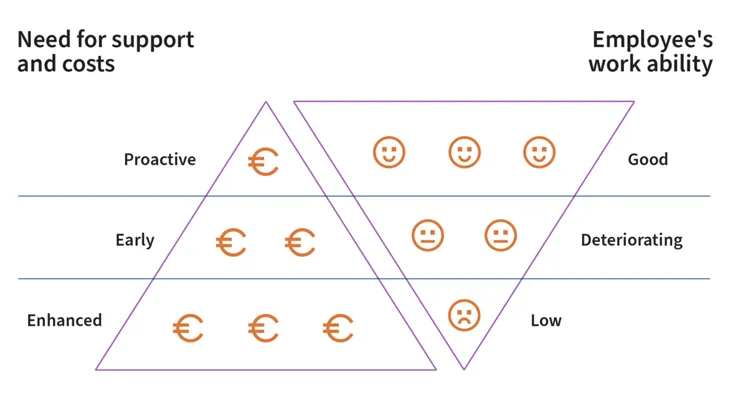
Why should you support employees’ work ability?
Supporting work ability is an investment that makes sense to the employer from an economic and human perspective and is also a statutory obligation. It does not necessarily require extensive development projects or major financial inputs.
When the workplace supports employees’ work ability, there is:
- a reduction in work-related health problems and absences
- a reduction in disability costs
- an improvement in labour productivity
- a decline in employee turnover, which reduces the costs of recruitment and job orientation.
In addition, healthy employees have a positive impact on:
- the atmosphere at the workplace
- customer experiences
- the employer’s reputation and success.
Read more about the impact of well-being at work on productivity:
- Työhyvinvoinnin tuottavuusvaikutukset tutkimuksen valossa (PDF) (in Finnish) – Akava WorksOpens in a new window.
- Digital path to work engagement? – Study of the linkage between employee well-being and productivity in a financial service company (in Finnish) – Aalto UniversityOpens in a new window.
Updated: 27/8/2026
What does the management of work ability mean?
The management of work ability is concerned with good human resource management. It refers to measures that the workplace is taking to support employees’ work ability. The management of work ability includes both proactivity and measures to support employees in continuing at work or returning to work after an absence. Essential aspects of the management of work ability include
- identifying and strengthening the resource factors of employees and work communities
- anticipating risks that threaten employees’ work ability, health and industrial safety
- supporting employees in continuing at work and returning to work in cooperation with other stakeholders, such as occupational health care.
Updated: 5/11/2025
Are you satisfied with the content on this page?
