To get the best help for your situation, first answer the questions on the guide's start page.
Suomi.fi
Go directly to contents.What do I do?
Supporting work ability at workplace- Guide's start page
- Supporting and managing work ability at workplaces
- Maintaining daily work ability
- Good supervisory work
- Issues affecting work ability at workplace
- Strengthening work ability
- Prevent employees’ work ability problems
- Pay attention to work ergonomics
- Promote recovery
- Provide sufficient employee orientation
- Help employees develop their skills
- Support healthy and safe working approaches and lifestyles
- Create an open and safe atmosphere in the work community
- Discuss with employees in their daily practice
- Make sure to regularly spend time on longer discussions with the employees
- Support the employee's partial work ability
- Responding to changes in work ability
- Examples of ways to support work ability
- Practices and plans for promoting and supporting work ability
- Checklist for promoting and supporting work ability
Strengthening work ability
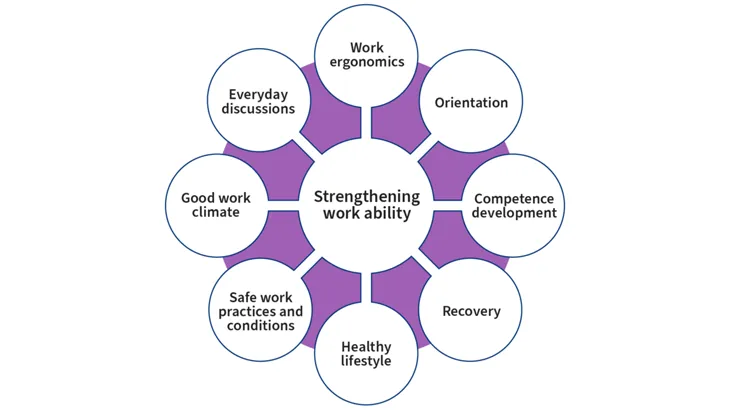
Prevent employees’ work ability problems
You can strengthen your employees’ work ability through various measures. It is easy to introduce various measures and new ways to the day-to-day practice at the workplace. This page provides you with various ideas for supporting employees’ work ability.
Updated: 4/9/2024
Pay attention to work ergonomics
Check that the work, work environment, tools and systems are designed and implemented to take into account the needs and constraints of different employees.
In work ergonomics, pay attention to issues such as:
- The dimensioning of work stations pays attention to employees’ measurements and dimensions. This enables employees to move as easily and efficiently as possible at their work stations.
- The work is developed to cause as little burned on employees’ memory as possible. Unnecessary distractions and interruptions are eliminated from work.
- Work shifts and breaks are planned so that employees have enough time to return from work.
Read how you can implement these things and learn more about ergonomics:
Updated: 3/9/2024
Information on all services is not available in your chosen language. Change the language of the site to receive information on services in other languages.
Promote recovery
Make sure that employees recover from work during the working day and between their shifts:
- Check that employees do not work too much overtime.
- Make sure that employees take enough breaks during the working day.
- Agree together at the workplace to make sure there is enough time for transitions and recovery between meetings.
Updated: 3/9/2024
Information on all services is not available in your chosen language. Change the language of the site to receive information on services in other languages.
Provide sufficient employee orientation
The aim of the orientation is that new employees get to know their workplace, colleagues and job-related expectations. Supervisors are usually responsible for employee orientation at the workplace. However, you can assign some of the related tasks to other employees. When more than one employee participates in the orientation at the workplace, new employees also get to know their co-workers.
Please note that employees who have been in the workplace for a longer period also need orientation at least when there are changes in their tasks and ways of working. Check whether your workplace has prepared a joint employee orientation plan.
Read about the issues that should be taken into account in the orientation:
- Good orientation is always worthwhile (in Finnish) - Finnish Institute of Occupational Health Opens in a new window.
- Top 10 checklist for employee orientation (in Finnish) – Finnish Institute of Occupational HealthOpens in a new window.
- Successful job orientation in the service sector (in Finnish) - Finnish Institute of Occupational Health Opens in a new window.
Updated: 3/9/2024
Help employees develop their skills
Make sure that employees have sufficient competence for their work and an opportunity to develop their skills. Studies indicate that up to 80% of learning during a career and related to work takes at work.
For example, you can offer employees different types of courses, training and coaching, or support them in studying independently.
More information: Employee competency - Job Market FinlandOpens in a new window.
Updated: 20/7/2026
Information on the services is not available in your chosen language. Change the language of the site to receive information on services in other languages.
Support healthy and safe working approaches and lifestyles
All employees are responsible for their health, but the supervisor can support employees’ healthy lifestyles. As a supervisor, you can also promote the healthy working approaches and lifestyles of employees with your own attitude and example.
You can also plan with your employees how to promote health at your workplace.
For example, you can:
- agree on taking breaks and exercising together
- discuss how you could adapt the working environment to promote healthy choices
- agree on joint meal breaks
Read more:
Updated: 5/9/2024
Create an open and safe atmosphere in the work community
When the atmosphere in the work community is open and safe, employees do not hesitate to give feedback and express their thoughts, ideas and opinions. A good sign of trust is a shared feeling that everyone’s opinion is appreciated.
When employees trust their supervisor and each other, they tell each other in good time if there is something that concerns them related to their work or condition. This prevents problems from getting too big.
It is also a good idea to discuss the positive things in the work community together.
Read more about interpersonal skills in the work community:
- Daily practices - Workplace where everyone feels good (in Finnish) - Mieli ryOpens in a new window.
- Working Together: A Handbook - The Centre for Occupational SafetyOpens in a new window.
- Becoming part of the work community - The Centre for Occupational SafetyOpens in a new window.
- At work without fear - psychological safety in the work community - Finnish Institute of Occupational HealthOpens in a new window.
- Work to belong program to reduce loneliness (in Finnish) - Helsinki MissioOpens in a new window.
Updated: 23/4/2026
Information on the services is not available in your chosen language. Change the language of the site to receive information on services in other languages.
Discuss with employees in their daily practice
Be genuinely interested in how the employees are doing and how they are coping. Make sure that you talk to the employees frequently enough, such as daily or weekly.
You can ask employees questions such as:
- How are you doing? How are you or how have you been?
- How is your work going?
- What kind of help would you need? How can I help you?
Also discuss regularly with your employees the positive things in their work as well as those burdening them.
Read more:
Updated: 22/4/2026
Make sure to regularly spend time on longer discussions with the employees
In addition to everyday discussions, it is also a good idea to have more systematic discussions with employees on a regular basis.
Reserve enough time for these discussions. Make sure that communication is also maintained during remote work, part-time work, leaves and absences.
Read more:
Updated: 3/9/2024
Support the employee's partial work ability
Every person with partial work ability is different. This is why the support for work ability must be based on what the employee is able to do and how this is taken into account in work tasks and the work community.
Adapting work tasks may be needed when
- the employee starts in a new job
- the employee's situation changes during the employment relationship
- the employee returns to work from sick leave.
When making adaptations, the employee's physical or cognitive needs must be considered, for example by
- adjusting work tasks or arranging working hours
- providing ergonomic tools, such as a customised work chair or speech-controlled software
- providing quiet workspaces or remote work opportunities
- preparing clear instructions and visual support materials for them
- appointing a support person or job coach.
Read more:
Updated: 18/12/2025
Information on all services is not available in your chosen language. Change the language of the site to receive information on services in other languages.
Are you satisfied with the content on this page?
