To get the best help for your situation, first answer the questions on the guide's start page.
Suomi.fi
Go directly to contents.What do I do?
Supporting work ability at workplace- Guide's start page
- Supporting and managing work ability at workplaces
- Maintaining daily work ability
- Practices and plans for promoting and supporting work ability
- Checklist for promoting and supporting work ability
Describe the work ability support model
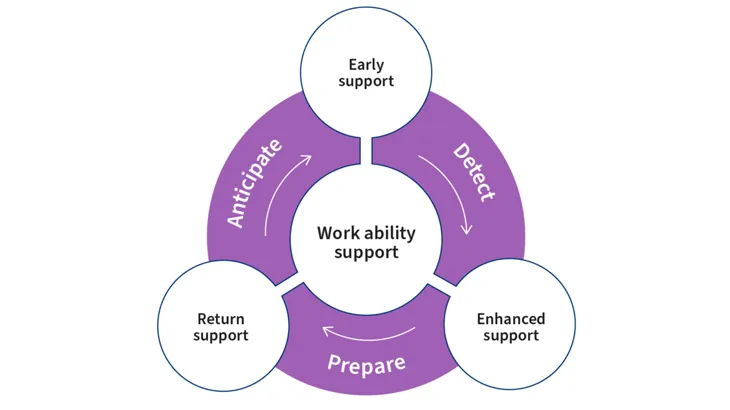
What does the work ability support model mean?
The employer must agree with the occupational health care provider and the personnel on measures to support the employees’ work ability.
In the work ability support model, compile the practices and instructions agreed at the workplace on how to
- anticipate factors affecting work ability and promote work ability
- support employees’ work ability as early as possible
- detect support needs and take measures
- monitor the success of the measures and prepare for returning to work, for example after a long sickness absence.
- support the employee after their return to work.
The agreed practices should be recorded, even at small workplaces. There is no ready-made basis for the work ability support model; the organisation can decide for itself how it will describe the model. It is often sufficient that the workplace has drawn up the necessary plans and instructions to promote occupational safety, occupational health and well-being at work.
When describing the model, decide which tools and methods
- supervisors can use in their own work
- employees can use to assess their own work ability
- management can use to monitor employees' work ability and develop workplace practices.
Updated: 3/9/2024
Information on the services is not available in your chosen language. Change the language of the site to receive information on services in other languages.
Early support model
The employer must prepare a written description of the practices for the early support of work ability together with occupational health care and employees.
The early support model is also referred to by other names, such as the early caring model, early intervention model and active support model.
In the early support model, describe
- what are the tasks and responsibilities of the employer, supervisor, occupational health care and employees
- which tools and methods are used in the workplace
- how to support work ability proactively
- how to monitor employees’ coping at work
- how to identify problems with work ability
- how are sickness absences reported and managed
- how to react to changes in work ability
- when and how is the occupational health discussion organised
- how to support the employee’s return to work after a long absence
- how is the use and functionality of the model is monitored.
More information on other websites:
Updated: 4/5/2026
Information on all services is not available in your chosen language. Change the language of the site to receive information on services in other languages.
Notification of absences due to illness
Employees are entitled to paid sickness absences based on employment contract legislation and their collective labour agreement. However, workplaces agree in more detail on the practices for how to act when an employee falls ill and how information is managed and monitored.
Agree on workplace’s practices together with occupational health care.
In the practices, note
- how many days an employee may be absent with just their own notification, i.e. by notifying the supervisor of the illness
- when the absence requires a certificate of sick leave issued by a physician or a public health nurse
- how you handle an employee's sensitive information.
Updated: 6/5/2026
Work adaptation model
The adaptation of work is a good way to support an employee’s work ability in situations where the work ability has already declined or is at risk of declining. It refers to measures that enable adapting work and the working environment to respond to the employee’s work ability.
In the work adaptation model, specify what adaptations are possible:
- How can work be adapted for reasons such as disability, illness, life event or cultural background?
- How to organise the statutory adaptation of work of a person with a disability?
- How can employees personally customise the content and approaches of their work?
When the workplace agrees on the practices for adapting work,
- supervisors can take measures before the employee has to leave their job, can monitor the results and make new changes if necessary
- employees understand that everyone has the same opportunity for the adaptation of work.
Read more about the work adaptation model and how it is done:
- A model for work adaptation - a guide for workplaces and professionals in supporting work ability (in Finnish) - Finnish Institute of Occupational Health publication in the publication archive of the administrative branch of the Ministry of Social Affairs and HealthOpens in a new window.
- A guide on the methods for adapting work when a mental health disorder affects work ability (in Finnish) - Finnish Institute of Occupational Health publication in the publication archive of the administrative branch of the Ministry of Social Affairs and HealthOpens in a new window.
Updated: 2/9/2024
Return to work practices
The support for the return to work aims to ensure that the employee returns to work safely and in a timely manner after a long sickness absence.
In the return to work practices, describe how
- to agree on practical matters at the beginning of the sickness absence
- to contact the employee during the sick leave
- the supervisor makes preparations for the return to work together with the employee and occupational health care
- the employee’s coping at work and work ability are monitored after the return to work.
Also include information about what kinds of means the supervisor can use to make preparations for the employee’s return to work in the practices.
Means that support return to work include
- limiting or reorganising tasks
- procuring tools and aids
- additional training and job control
- reduced working hours
- partial daily sickness allowance
- vocational rehabilitation.
Updated: 2/9/2024
Are you satisfied with the content on this page?
